What is Windows Prefetch? Prefetch is a feature, introduced in Windows XP, that stores specific data about the applications you run in order to help them start faster. Prefetch is an algorithm that helps anticipate cache misses (times when Windows requests data that isn’t stored in the disk cache), and stores that data on the hard disk for easy retrieval. This data is located in \Windows\Prefetch, and, as the theory goes, periodically clearing out the data in this folder (say, once a month) will improve performance.
But with older entries gone, there will be less data to parse, and Windows should be able to locate the data it needs more quickly. Any performance gains you may see will be minor (if you see any at all), but those users wishing to squeeze every last CPU cycle out of their computers will want to try this one. Note that deleting Prefetch data may increase boot time slightly, but only the next time you boot Windows. Each subsequent boot should proceed normally, since the prefetch data will already be present for the programs Windows loads when it boots. The Prefetcher’s configuration is stored in the windows Registry at.
If you've added a hard drive to your system you can move pagefile.sys to free up space on your original drive and speed up your system. There’s a large hidden file. Among the many hidden files and folders in Windows, three that you might come across are $Recycle.bin, Recycler and System Volume information. Here we explain what. I've found "Stalled Printer Repair" very useful. I does the same thing, but without me having to remember how to do it manually! Works fine on XP and Vista, and can. We might be at Peak TV now, but we’ve been at Peak Books for at least a century, and if you enjoy reading, it’s physically impossible to read every book you want.
HKEY. If you notice a performance issue caused by an “optimizer” software that changed this registry value to non- 3, bring back the original value to 3. Ben Carigtan shows you how it’s done!

Introduction This document summarizes changes made in all the 1.5.0 update releases, including a link to the original 1.5.0 release notes. Note that bug fixes in.
What is pagefile. I move it?//There’s a large hidden file on my disk that’s taking up a bunch of space called pagefile. What is pagefile. Assuming it’s something I need, can I move it to another drive? Pagefile. sys is your Windows virtual memory swap file. When the applications you’re running on your computer end up needing more RAM than you actually have, Windows will start shuffling things around and use your hard disk as “virtual” memory. At the sometimes high cost of speed (your hard disk, and thus virtual memory, is much slower than actual RAM) you avoid getting an out of memory error.


Pagefile. sys is the area that Windows sets aside for that. And yes, you can move it. In fact, if you have more than one drive installed on your machine and your system uses virtual memory often, moving it can result in a performance boost.
Pagefile. sys. When Windows creates pagefile. RAM installed on your machine.
For example on the machine I’m using now I have 8 gigabytes of RAM, and sure enough: C: > dir /a: h. Not only does this free up space on “C: ”, but it can reduce hard disk contention caused by heavy use of C: by offloading some of the activity to a different drive. Caveats: “Be it for performance or for disk space, moving pagefile.
It needs to be a different physical drive. Moving the paging file to a different partition on the same drive will probably just slow things down further as the disk heads on that drive need to move further as they access information from the original drive and the new location of the paging file. It should not be on a USB (or Firewire) external drive. Not only are these interfaces often too slow to positively impact performance, accidentally pulling the cable will crash your machine. It should not be a flash drive. Flash memory wears out, and heavy swap file usage can wear out flash memory exceptionally quickly. But if you have a second, internal drive, then moving pagefile.

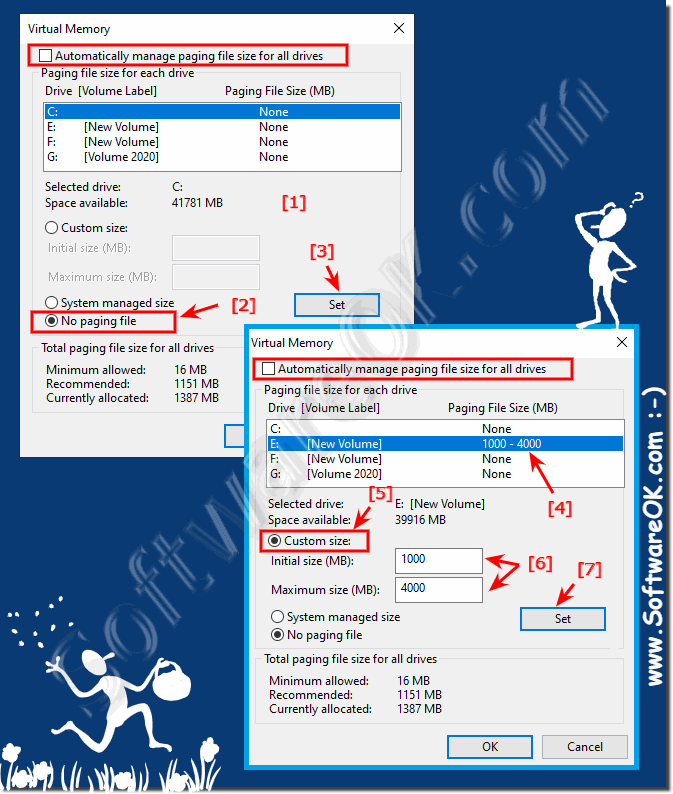
Moving pagefile. sys. Right click on “My Computer“, or the “Computer” item in your start menu and click on properties. In Windows 7 click on the Advanced system settings link.
Click on the Advanced tab. In the box labeled “Performance”, click on the Settings button. Click on the Advanced tab in the resulting dialog. That long, strange sequence should have you looking at a dialog similar to this: Therein you’ll see the “Virtual memory” section showing how much space has been set aside for your paging files. Click on Change. After the changes above and a reboot pagefile. C: and appeared on D. Some notes about the choices made above: “System Managed Size” is appropriate, unless you have a specific reason to need it to be otherwise.
Most people do not. Of the drives that showed as available on my machine only C: and D: were appropriate locations for the paging file.
B: is USB drive, and F: and P: are both True. Crypt volumes. Only C: and D: are real internal and separate drives. If only C: is listed on your machine, then you have nowhere to move your paging file to. You can run without virtual memory if you like – but depending on how you use your computer you may run into out of memory situations much sooner. Be it for performance or for disk space, moving pagefile.


/http%3A%2F%2Fakmedia.digidesign.com%2Fsupport%2Fimages%2FPC%20Wizard%20w-Box%20smaller_45577.jpg)
/https%3A%2F%2Fupload.wikimedia.org%2Fwikipedia%2Fen%2Fthumb%2F1%2F12%2FPrevious_Versions_Vista.png%2F300px-Previous_Versions_Vista.png)
/http%3A%2F%2Fwww.wikihow.com%2Fimages%2F1%2F15%2FCreate-Recovery-Discs-for-Windows-Vista-in-HP-Recovery-Manager-Step-11.jpg)
/http%3A%2F%2Fassets.aten.com%2Fproduct%2Fimage%2FCS1734A-Desktop-KVM-Switches-OL-large.jpg)